






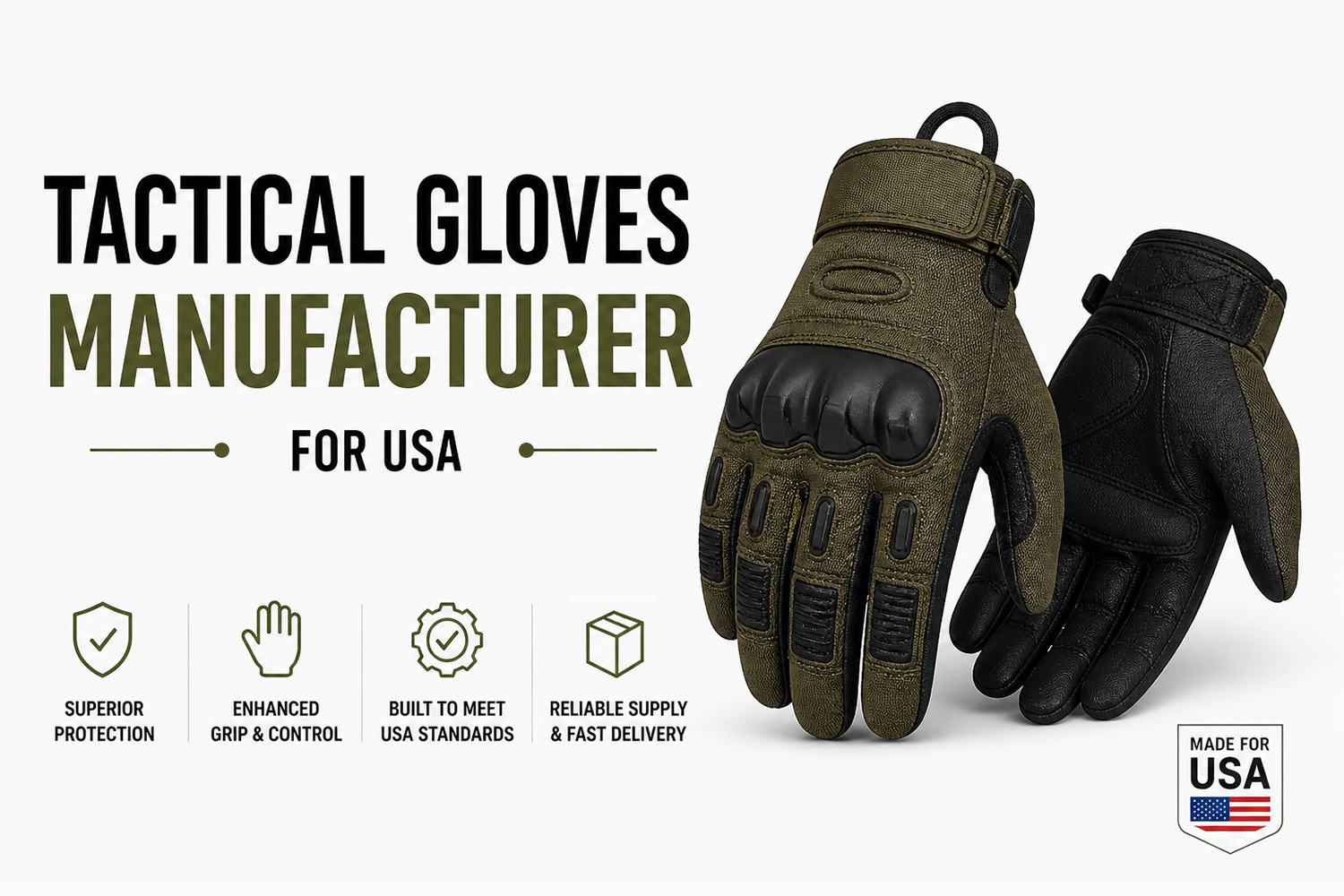
Tactical Gloves Manufacturer for USA: High-Performance Hand Protection for Industrial and Defense Professionals
What Are Tactical Gloves and Who Needs Them?
Tactical gloves are specialized hand protection designed for high-risk professional environments including military operations, law enforcement, construction, oil & gas, and industrial manufacturing. Unlike standard work gloves, tactical gloves combine cut resistance, impact absorption, flame protection, and dexterous grip in a single garment built to perform under extreme conditions.
In the United States, hand injuries account for approximately 23% ofall occupational injuries annually, according to the Bureau of Labor Statistics — making hand protection one ofthe highest-priority safety investments for employers across defense, energy, and construction sectors.
Why Standard Gloves Fail in High–Risk Environments
Standard work gloves are engineered for light-duty tasks. They typically lack:
- Ballistic or cut resistance (required for law enforcement and military use)
- Flame retardancy (mandatory in oil & gas and firefighting applications)
- Impact knuckle protection (essential for construction and heavy machinery)
- ANSI/ISEA compliance (legally required for many US worksites)
This protection gap creates direct liability exposure for employers and safety risk for workers — which is why US procurement teams increasingly specify certified tactical gloves rather than standard PPE.
Types ofTactical Gloves: A Complete Comparison
Different operational demands require different glove designs. The table below summarizes the four primary categories used across US industries.
|
Glove Type |
Primary Protection | Key Material | Best For |
|
Cut-Resistant |
Blades, abrasions | Kevlar, HPPE |
Law enforcement, industrial |
|
Impact-Resistant |
Blunt force, knuckle trauma | D3O, padding inserts |
Military, construction |
| Flame-Resistant | Heat, open flame | Nomex, FR leather |
Oil & gas, firefighting |
| All-Purpose
Tactical |
General hazards | Synthetic leather,
neoprene |
Security, outdoor ops |
Cut-Resistant Tactical Gloves
Cut-resistant tactical gloves use Kevlar or high-performance polyethylene (HPPE) fibers to achieve ANSI cut level A4–A9 ratings. Workers exposed to blades, sharp metal edges, or glass should select gloves rated at ANSI/ISEA 105 A6 or higher. These gloves are standard issue in US law enforcement evidence collection, industrial assembly, and K-9 handler units.
Impact-Resistant Tactical Gloves
Impact-resistant gloves incorporate molded TPR (thermoplastic rubber) or D3O padding over the knuckles, back ofhand, and finger joints. They reduce blunt-force injury risk by up to 60%, according to EN 13594 impact testing data. Military personnel, construction workers operating heavy equipment, and SWAT teams are the primary users in the US market.
Flame–Resistant (FR) Tactical Gloves
FR tactical gloves manufactured from Nomex — a meta-aramid fiber — can withstand sustained contact temperatures up to 300°C (572°F) before structural breakdown. NFPA 2112 certification is the benchmark standard for flame-resistant hand protection in US oil & gas operations.
Workers in refinery, pipeline, and arc flash environments should not use uncertified gloves regardless ofcost savings.
All–Purpose Tactical Gloves
All-purpose tactical gloves balance protection across multiple hazard categories without specializing in any one. Commonly used by security professionals, outdoor law enforcement, and private military contractors, these gloves typically feature synthetic leather palms, neoprene knuckle protection, and touchscreen-compatible fingertips — a feature now specified by over 70% of US law enforcement procurement contracts.
Materials Used in Tactical Gloves Manufacturing
The protection level, durability, and comfort oftactical gloves are determined primarily by
material selection. Here are the six core materials used by certified manufacturers supplying the US market:
Kevlar (para–aramid synthetic fiber) Provides 5× the tensile strength ofsteel at equal weight. Used in cut-resistant and puncture-resistant glove layers. Rated ANSI/ISEA 105 A4–A9 depending on construction weight and layering.
Nomex (meta–aramid) The industry standard for flame-resistant tactical gloves. Nomex does not melt, drip, or support combustion — a critical property for oil & gas and firefighting applications. Compliant with NFPA 2112 and NFPA 70E.
D3O and TPR Polymers Rate-sensitive impact protection materials used in knuckle guards. D3O remains flexible during normal movement but hardens on impact, reducing trauma force transfer. Used in military-specification gloves supplied to US DoD contractors.
Synthetic Leather (Clarino, Pittards) Replaces natural leather in premium tactical gloves. Offers superior grip consistency across wet and dry conditions, 40% greater abrasion resistance than full-grain leather, and consistent sizing accuracy across production runs.
Neoprene Provides waterproofing, insulation, and structural flexibility. Used in all-weather tactical gloves for maritime, cold-climate, and flood-response operations.
HPPE (High–Performance Polyethylene) Lightweight cut-resistant fiber used as an alternative to Kevlar in gloves requiring maximum dexterity. Common in law enforcement and surgical PPE applications.
US Safety Standards and Certifications Every Buyer Must Know
Tactical gloves sold into the US market must comply with specific safety standards. Non-compliant gloves expose importers and employers to OSHA citation risk under 29 CFR 1910.138 (hand protection requirements).
|
Standard |
Scope |
Required For |
|
ANSI/ISEA 105 |
Cut, abrasion, puncture, heat |
Most US industrial and law enforcement specs |
|
EN 388:2016+ |
Mechanical hazard performance |
Import compliance, EU-standard buyers |
|
NFPA 2112 |
Flame resistance for industrial flash fire |
Oil & gas, refinery, arc flash |
|
NFPA 70E |
Arc flash protection |
Electrical work environments |
|
ISO 9001:2015 |
Manufacturing quality systems |
OEM/private label sourcing verification |
|
MIL-SPEC (various) |
Military performance standards |
DoD contractor supply chains |
Buyer tip: Always request third-party test reports — not just self-declared compliance. Reputable tactical gloves manufacturers provide SGS, Intertek, or Bureau Veritas lab certifications with each production batch.
How Tactical Gloves Are Manufactured: Step–by–Step
Understanding the manufacturing process helps US buyers evaluate supplier capability and identify quality risks before placing bulk orders.
Step 1 — Material Sourcing and Verification
Raw materials (Kevlar, Nomex, synthetic leather) are sourced from certified suppliers and tested against incoming QC specifications. Reputable manufacturers maintain traceability records for every material lot — a requirement for DoD and government supply chains.
Step 2 — Pattern Design and Ergonomic Prototyping
Custom patterns are developed using CAD software and tested across multiple hand size profiles. Ergonomic fit testing ensures that protective layers do not restrict dexterity — a common failure point in lower-cost gloves. Prototypes undergo 40+ hours ofwear testing before production approval.
Step 3 — Precision Cutting
Material panels are cut using computerized die-cutting or laser systems to ensure dimensional consistency across large production runs. Manual cutting introduces size variation ofup to 3mm
— unacceptable for certified PPE manufacturing.
Step 4 — Stitching and Assembly
High-tensile nylon or Kevlar thread is used for all structural seams. Stitch density is typically 8–10 stitches per centimeter for load-bearing seams. Double and triple stitching is applied at stress points (thumb crotch, fingertip, wrist closure).
Step 5 — Reinforcement Integration
Knuckle guards, palm reinforcements, and grip patches are bonded and stitched into position. TPR and D3O inserts are press-fitted into pre-formed pockets rather than adhesive-bonded — adhesive methods delaminate under repeated use and washing.
Step 6 — Quality Control and Compliance Testing
Each glove lot is tested against the applicable standard (ANSI, EN 388, NFPA). Testing includes cut resistance (circular blade method), abrasion resistance (Martindale), seam strength (≥ 50N minimum), and dimensional accuracy. Rejection rates above 2% trigger full batch review.
Step 7 — Private Label Packaging and Export
Gloves are packaged to client specification — including custom hang tags, poly bags, inner boxes, and master cartons — and cleared for US import under the correct HTS codes to avoid customs delays.
Choosing a Tactical Gloves Manufacturer for the USA Market
What to Look For in an OEM Partner
Sourcing tactical gloves for the US market involves more than comparing unit prices. The right manufacturing partner delivers:
- Verified certifications — ANSI/ISEA 105, NFPA, ISO 9001 with third-party lab reports
- US market experience — familiarity with OSHA requirements, import regulations, and American sizing standards
- Low MOQ flexibility — ability to run pilot production runs before full commitment
- Private label capability — in-house design, custom packaging, and brand labeling
- Reliable lead times — typically 45–75 days from order confirmation for custom production
Red Flags When Evaluating Suppliers
Avoid manufacturers who:
- Cannot provide third-party test certificates (only self-declaration)
- Have no documented QC process or rejection rate data
- Cannot provide references from US-based brands or distributors
- Quote lead times under 30 days for custom orders (a sign ofinventory reselling, not manufacturing)
Garmor Corporation: OEM Tactical Gloves Manufacturer for the USA
Garmor Corporation is an established OEM and private-label tactical gloves manufacturer with a proven supply record to US brands, distributors, and defense contractors.
Garmor’s core manufacturing capabilities:
- Full OEM and private-label production with custom design from concept to delivery
- Certified compliance with ANSI/ISEA 105, EN 388, NFPA 2112, and ISO 9001:2015
- Bulk production capacity for US wholesale and distribution partners
- In-house material testing and QC with third-party lab verification available
- US import documentation support including HTS classification and C-TPAT aligned logistics
For brands building or scaling a tactical gear line for the American market, Garmor provides the manufacturing infrastructure and compliance expertise to deliver products that meet procurement specifications from day one.
FrequentlyAsked Questions About Tactical Gloves for the USA
What are tactical gloves used for?
Tactical gloves protect hands in high-risk professional environments — including military operations, law enforcement, construction, oil & gas production, and industrial manufacturing. They are engineered to resist cuts, impacts, flames, and abrasions beyond the capability of standard work gloves.
What is the best material for tactical gloves?
The best material depends on the primary hazard. Kevlar provides the highest cut resistance (ANSI A6–A9). Nomex is the standard for flame resistance. D3O offers superior impact absorption. Most high-performance tactical gloves combine two or more materials in a layered construction.
Do tactical gloves need to meet US safety standards?
Yes. Tactical gloves sold to US employers must comply with ANSI/ISEA 105 for mechanical hazards and NFPA standards for flame-resistant applications. OSHA’s 29 CFR 1910.138 requires employers to provide compliant hand protection based on documented hazard assessment.
Can tactical gloves be customized for my brand?
Yes. OEM manufacturers like Garmor offer full customization: materials, protection levels, color, logo embroidery or printing, custom sizing, and private-label packaging. Minimum order quantities typically start at 300–500 pairs for custom production runs.
Which industries use tactical gloves most in the US?
The highest-volume US buyers oftactical gloves are: military and defense contractors, law enforcement agencies, oil & gas operators, construction general contractors, and electrical utilities. The US tactical gloves market is projected to grow at a CAGR of 6.2% through 2030, driven by increasing PPE mandates and defense spending.
What is the difference between tactical and regular work gloves?
Regular work gloves are designed for general-purpose protection at low cost. Tactical gloves are engineered to specific protection standards (ANSI, NFPA, MIL-SPEC), use advanced materials (Kevlar, Nomex, D3O), and are tested to measurable performance benchmarks. In high-risk environments, using non-tactical gloves where tactical protection is required creates direct legal liability for employers.
How long does custom tactical glove manufacturing take?
Custom tactical glove production typically takes 45–75 days from approved sample sign-off, depending on material sourcing, order volume, and customization complexity. Rush production (30–40 days) is available from some manufacturers at a premium, but is not recommended for certified PPE where QC timelines cannot be compressed.
Can I order tactical gloves in bulk from a US–market manufacturer?
Yes. OEM manufacturers supply bulk orders to US distributors, government procurement offices, and brand owners. Standard bulk MOQs range from 500–2,000 pairs per SKU. Volume pricing tiers typically begin at 1,000 pairs.
Are tactical gloves suitable for extreme weather conditions?
Yes, with the right selection. Insulated neoprene gloves protect in cold weather down to -20°C. FR-rated Nomex gloves protect against sustained heat. Waterproof membrane gloves (Gore-Tex or similar) are used for wet and maritime operations. Specify the temperature range and environmental conditions when requesting a quote.
How do I verify a tactical gloves manufacturer is legitimate?
Request: ISO 9001 certificate with audit date, ANSI/ISEA 105 test reports from an accredited lab (SGS, Intertek, BV), references from US-based customers, and a facility audit report or virtual factory tour. Legitimate manufacturers provide all ofthese without hesitation.
Summary: Key Facts About Tactical Gloves for US Buyers
- Hand injuries account for ~23% of US occupational injuries annually (BLS data)
- ANSI/ISEA 105 and NFPA 2112 are the primary compliance standards for the US market
- Kevlar, Nomex, and D3O are the three highest-performance materials in tactical glove manufacturing
- Custom OEM production typically requires 45–75 day lead times and 300–500 pair MOQs
- Third-party lab certification (SGS, Intertek, BV) is the only reliable way to verify compliance claims
- The US tactical gloves market is growing at ~6.2% CAGR through 2030
Garmor Corporation — OEM Tactical Gloves Manufacturer | Supplying US brands, distributors, and defense contractors with certified, high-performance hand protection.
Ready to Source High-Quality Tactical Gloves for the USA Market?
Worker safety is not something businesses can afford to compromise. Whether you’re a brand, distributor, or procurement manager in the United States, choosing the right manufacturing partner is critical to delivering high-quality protective gear.